This nebula is often listed as PuWe 1, which stands for the name of the discoverers Purgathofer and Weinberger. In galactic coordinates it should be referenced as PN G158.9+17.8. It is positioned in the constellation Lynx near the borders to Auriga and Camelopardalis. This object is good reachable from northern Germany.
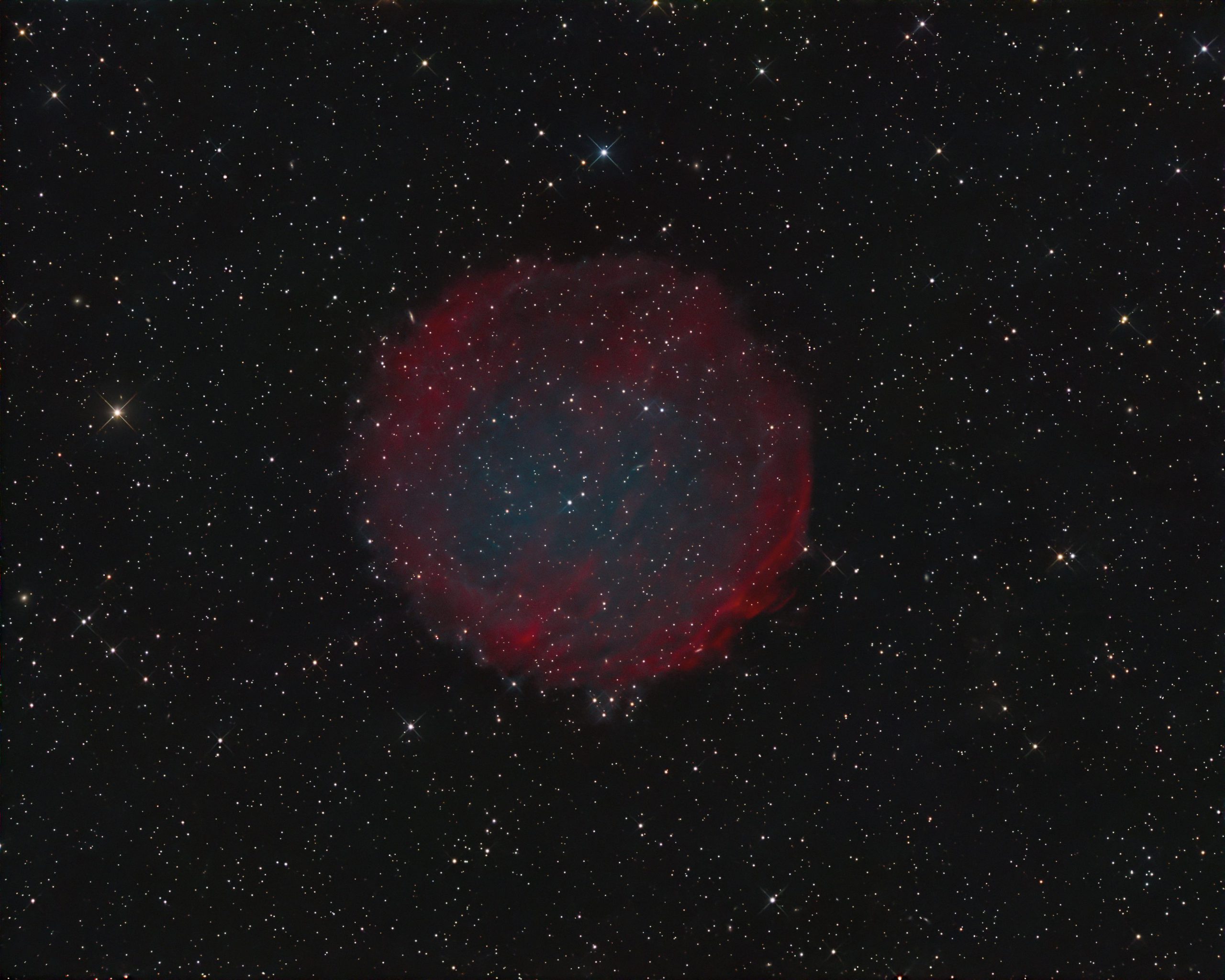
According to its discoverers this quite faint nebula delivers a red and a blue surface brightness of 23.7 mag / arc sec2 and 26.3 mag /arc sec2 [1]. This is an indication why that nebula asks for long exposure times. Compared to other available pictures my photo with an exposure time of 29 h is still a rather short exposure.
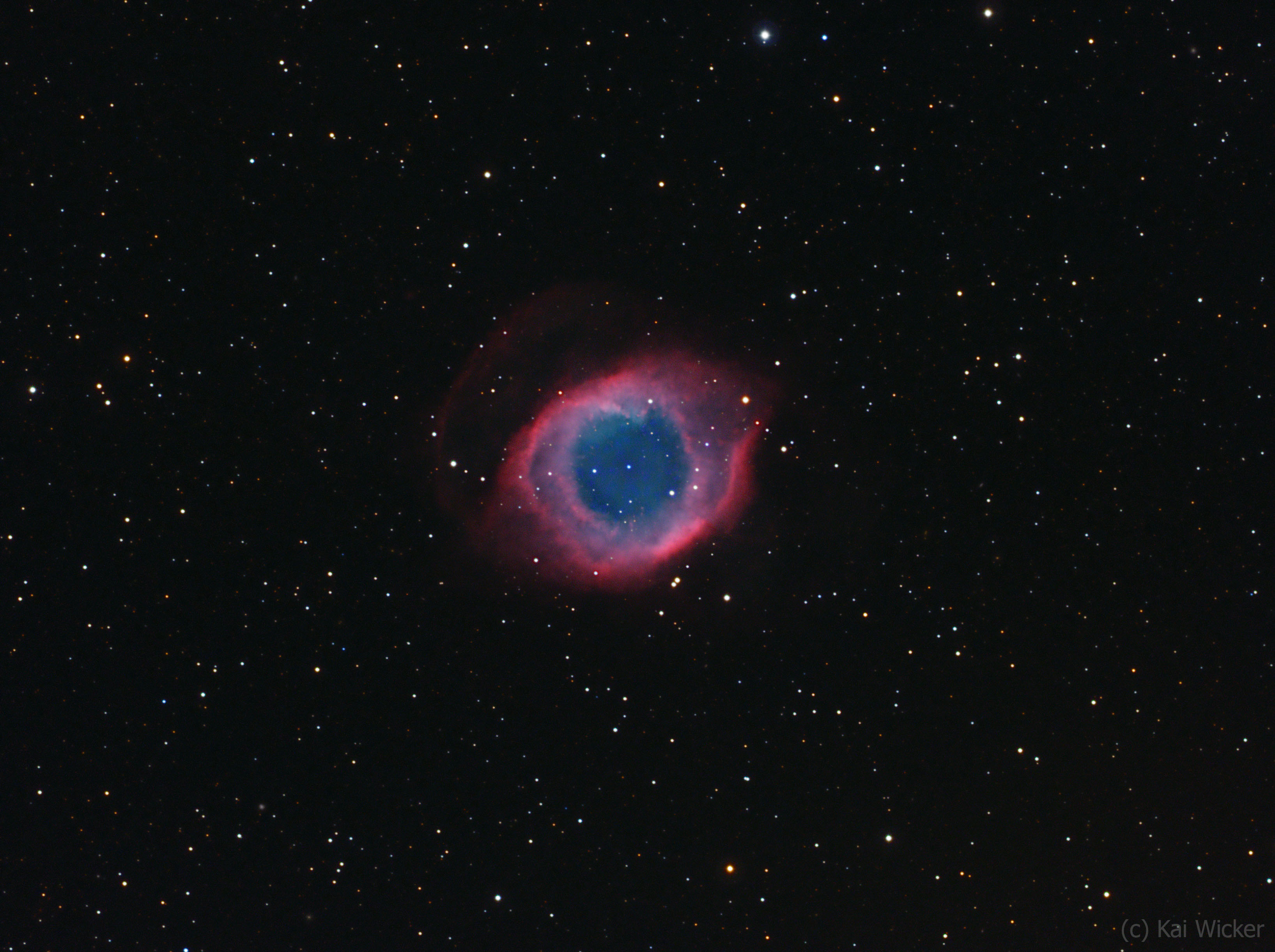
This nebula is one of the planetary nebulas with the largest apparent size. Due to [1] this is a consequence of both, the close distance (approx 140 pc) and geometrical size (approx. 0.8 pc). The size is again a consequence of the presumably great age of this nebula. In their letter the authors compare this nebula with the famous Helix Nebula, which is the other large planetary at our skies.
The Set-Up
The frames for this picture have been collected in March 2022 in Borgfeld. They cover 154 frames taken with two different monochrome cameras at my 10″ Newton Astrograph.
| Data | |
| Object | PuWe1 North is up (PW = 1.7°), scale is 1.00“ / pix Field of view: 56′ 36.7″ x 45′ 17.1″ Image center: RA: 6h 19m 25s Dec: +55° 36′ 10“ |
| Place | Bremen-Borgfeld, Germany; 8 nights in March 2022 |
| Scope | 10″ Newton Astrograph |
| Image Train 1 | Atik 490 EXm with TS2Korr at f/D=2.8, scale 1.02 arc sec / pix |
| Image Train 2 | Atik 383 L+m with TSWynne68 at f/D=3.8, scale 1.17 arc sec / pix |
| RGB: 14/9/33/8 x 2 min with Atik490, Baader LRGB H-alpha: 24 x 20 min with Atik 383, Baader 7 nm [OIII]: 55 x 20 min with train 2, Baader 8 nm RGB: 11/16/17 x 2 min with train 2, Baader LRGB Sum: 28h 50m |
|
| Mount | Avalon Linear |
| Guiding | PHD-Guiding, Lodestar, off-axis guiding |
| Processing | SQM Pro, PI |
Stars and Spikes
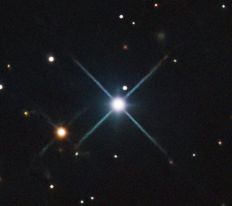
When one looks at the stars more closely, one can see strange spikes. Two sets can be identified, each consisting of four spikes. The explanation is quite simple. What is seen here is the merging of two different instrument/camera characteristics. The first set comes from the KAF-8300, which surprisingly also shows spikes. These spikes are caused by the microlens array of the KAF. Incidentally, this is a well-known feature of KAF chips. In this image, the spikes run almost parallel to the edges and are faint and fairly diffuse. The second set of spikes runs almost diagonally across the image and is caused by the struts of the Newtonian secondary mirror.
Comparison
The original data bummed on my hard disk since 2022. I never came to an acceptable processing result. In December 2025 I tried it once more. In the meantime the area specific deconvolution and more convenient gradient removal became available. With these tools a simpler processing leads to a adequate processed result which seem less „overprocessed“ compared to the 2022 result.
This mouseover shows the final result and some underlay data in order to give impression of the data structure and quality. The September 2022 picture is included to underline, why it was not satisfying for me. The starless H-alpha and [OIII] images are integrated as well. A significant intensity difference between H-alpha and [OIII] is noticeable.
References
| [1] | Purgathofer, A., Weinberger, R., Astron. Astrophys. 87, L5-L6 (1980) |